
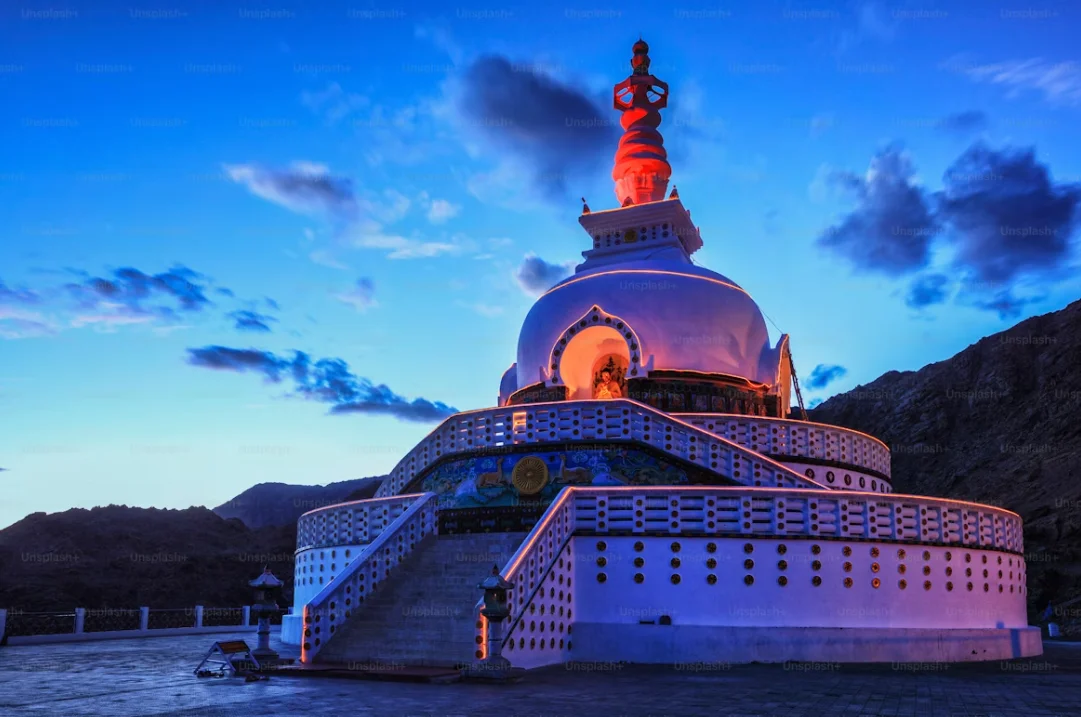
What Makes Sunrise at Shanti Stupa So Special?
There’s something surreal about witnessing a new day begin at 11,841 ft. with Leh Shanti Stupa.
The air is cold, and the sky slowly shifts from dark blue to gold. The Stupa’s white dome starts to glow with soft sunlight. You don’t hear traffic or people—only the wind and an occasional chant in the background.
It doesn’t feel like sightseeing. It feels like… waking up with the world.
My Moment of Stillness at Shanti Stupa Leh
It’s rare to find such silence these days. This was one of those moments I didn’t want to capture on my phone. I wanted to feel it, remember it.
I arrived just before sunrise. There were barely four people around.
As the first light hit the Himalayas, I sat down on the cold stone floor, closed my eyes, and took a deep breath.
For those few minutes, it didn’t feel like I was in Leh.
It felt like Leh was inside me—breathing, still, and present.
Where Is Shanti Stupa Located and How to reach there?
Shanti Stupa is located in Leh, Ladakh, nestled on a hilltop in Chanspa.
It overlooks the Indus Valley and the mighty Zanskar mountain range, offering panoramic views of the entire Leh town.
How You can reach Shanti Stupa from Leh Town:
- A short 10-minute drive from Leh Market. Shanti Stupa located 5 kms from the leh market.
- You can climb around 500 steps from Chanspa Road—a peaceful uphill trail lined with fluttering prayer flags, especially serene before sunrise.
Why Shanti Stupa Must Be on Your Ladakh List
· The foundation was laid in 1983 with support from Japanese and Ladakhi Buddhists, using local labor and funding from both Japan and India.
· It was built in 1991 by Japanese Buddhist monk Bhikshu Gyomyo Nakamura to promote world peace and harmony.
· The Stupa was built to celebrate 2,500 years since Buddhism began and to represent its deep spiritual value.
· The 14th Dalai Lama, Tenzin Gyatso, placed Buddha’s relics at the base of the Stupa and inaugurated it.
· Its purpose is to share a message of peace, prosperity, and global unity.
· The Stupa is a quiet space used for meditation, prayer, and peaceful reflection, offering panoramic views of Leh.
· It situated at an altitude of 3,609 meters (11,841 ft) and it’s accessible by road or a climb of around 500 steps.
· At night, the Stupa is beautifully lit, making it a serene and striking landmark.
· It is located close to Leh Palace, allowing travellers to visit both sites conveniently.
· For anyone visiting Ladakh, Shanti Stupa is a must-see because of its cultural significance and peaceful atmosphere.
What is the Best Time to Visit Shanti Stupa for Sunrise
| Month | Time to Arrive | Tips |
| May to September | 5:00 – 5:30 AM | Wear a light jacket, skies are clear |
| October to March | 6:15 – 6:45 AM | Carry layers, mornings are freezing |
Note : Aim to reach 15 minutes before sunrise for a front-row view of the Himalayan glow.
Best Viewpoint Tip for Leh Shanti Stupa

As you enter the Stupa, walk to the railing on the eastern side, opposite the entrance. From there, you’ll see a view that stays in your memory forever.
From here, you’ll see the sun rise directly behind the mountains, with prayer flags gently moving in the breeze. It’s a perfect frame—no filter needed.
Why You Shouldn’t Miss This Sunrise At Leh Shanti Stupa
Most people come to Ladakh for adventure.
But Shanti Stupa gives you something else—silence, clarity, and grounding.
If you’re someone who seeks meaning in travel, not just checklists—this sunrise will stay with you long after your trip ends.
Conclusion:
Shanti Stupa is not just a destination—it’s an unforgettable life time experience.
At sunrise, it becomes a mirror.
You don’t just see the view. You see yourself, clearer.
If you ever find yourself in Leh, gift yourself this moment.
No checklist. No rush. Just you, the light, and the silence of the mountains.
FAQs About Visiting Leh Shanti Stupa
What is the story of Shanti Stupa Leh?
This Stupa is Built by Japanese monk Nakamura in 1991, Shanti Stupa was created to spread peace and celebrate 2,500 years of Buddhism. The 14th Dalai Lama placed Buddha’s relics inside, making it a sacred symbol of unity.
What is inside Leh Shanti Stupa?
Inside rests a golden Buddha statue in deep meditation, sacred paintings narrating his life, and relics placed by the Dalai Lama. The silence inside feels like a whisper from the past calling for inner peace.
What is the ticket price of Leh Shanti Stupa?
Entry is free. You don’t need a ticket to feel the sunrise touch your soul. Just respect the calm, remove your shoes, and walk in gently—like you’re entering a place meant for reflection.
What is the dress code for Shanti Stupa Leh?
There’s no strict code, but modest clothing is expected. Cover shoulders and legs, avoid flashy outfits. It’s a spiritual place—your outfit should reflect calmness, not attention.
How old is Shanti Stupa?
Leh Shanti Stupa was completed in 1991, making it over 30 years old. Though modern in age, it holds the timeless energy of ancient teachings and sunrise prayers.
Do I need a guide While Visiting Shanti Stupa?
Not at all. You can explore it solo. But having someone local might add to your understanding of its Buddhist symbolism.
Are there restrooms or cafés near Shanti Stupa?
There are a few shops and cafés near the base. But nothing is open during sunrise. Carry a bottle of water and snacks according to your preference.
Can I meditate in leh Shanti Stupa?
Yes. Many visitors come for meditation. Just find a quiet spot and soak in the energy.
Is it safe to visit Shanti Stupa early morning?
Yes, it’s completely safe. Locals and early risers visit daily. The area is well-maintained and peaceful.